The Real Line Dividing Brigantine's Housing Market Isn't the Price Tag
August 20, 2026
August 20, 2026
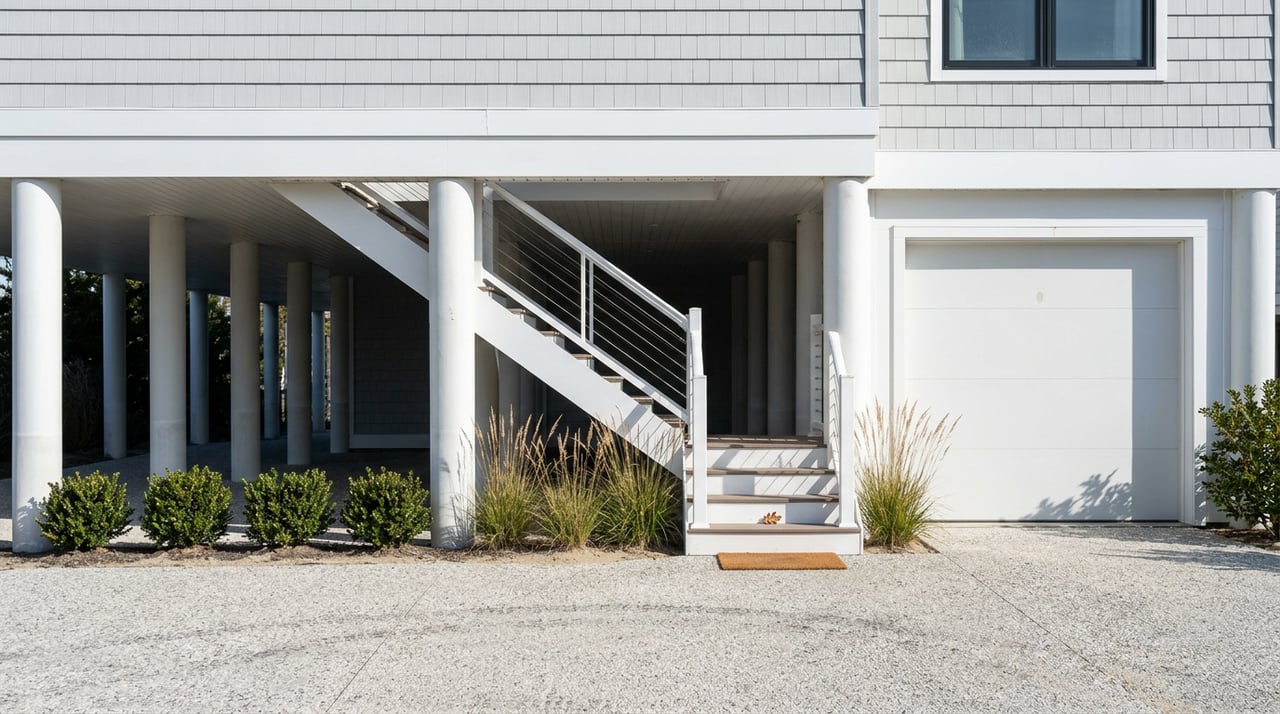
Two three-bedroom homes go up for sale on the same block this month, both listed around $700,000. One is a raised, piling-set build finished in the last few years. The other is a ground-level bungalow that has been on its original foundation since before anyone reading this was born. On paper, they look like the same purchase. They are not. The gap between them shows up later, in a flood insurance quote that can run thousands of dollars apart for the exact same coverage, on the exact same island, a few hundred feet from the exact same water.
That gap is the story most Brigantine buyers never hear until they are already under contract.
Ask around and you will hear that Brigantine's median home price sat near $689,000 in April 2026, with homes averaging 35 days on the market, down from 47 days the year before. That figure comes from Movoto's read of the local market, and it is a reasonable snapshot. But look at a different data feed for the same season and the picture gets less tidy. Redfin's March 2026 numbers showed homes sitting for 129 days on average, more than double the 66 days recorded a year earlier, on a base of just 20 recorded sales that month.
Both readings can be accurate and still tell you almost nothing about what a specific house will cost you to keep. Brigantine only moves a few dozen homes in a typical month. A single sale of an oceanfront rebuild or a single sale of an aging bayside bungalow can swing the median or the days-on-market figure by weeks. The price tag on a listing sheet is a starting point for a negotiation, not a summary of what ownership actually costs. The number that predicts your real annual cost lives somewhere else entirely: in the year the house was built, and in whether it has been brought up to current flood elevation standards.
Every property in Brigantine sits inside a FEMA-designated flood hazard area, a fact the city's own Construction Office states plainly on its flood information page. What separates one house from another isn't whether it's exposed to flood risk. It's whether it was built before or after the city's pre-FIRM cutoff of January 1, 1975.
Homes built before that date have historically qualified for subsidized National Flood Insurance Program rates, a legacy break that assumed less about a structure's actual elevation and construction. That subsidy has been unwinding for over a decade. The 2012 Biggert-Waters Flood Insurance Reform Act directed FEMA to phase out subsidies on pre-FIRM properties so premiums better reflect real risk, a shift that the Rutgers Climate Change Resource Center has tracked across the state, noting that pre-FIRM properties make up roughly 37 percent of New Jersey's housing stock. Brigantine's own building trade confirms the local effect. Homeowners whose houses sit below base flood elevation are watching premiums climb by thousands of dollars a year as the old subsidy erodes, according to McHugh Builders, a Brigantine-based construction firm that has raised homes across the island.
Owning a pre-1975 house on its original foundation is not a violation of anything. It is legal, insurable, and in many cases perfectly livable. It is also a house whose insurance cost is moving in one direction, while a fully elevated new build's cost has already been priced to reflect the standard it meets today.
This is the part that explains what you're seeing on your daily walk around the island. Older bungalows keep coming down, replaced by taller homes on raised foundations. That is not a style preference. It's an economic response to the elevation math.
Ted McHugh, who has spent more than two decades building on the island and runs McHugh Builders, points out that Brigantine's flood "Action Level" starts at just 5.5 feet even in what's mapped as a comparatively safer A-Zone. For most custom builds, that means driving pressure-treated timber piles 20 to 30 feet or more into the sand to reach stable ground, because standard footings on a barrier island shift over time. It also means the city imposes its own freeboard requirements on top of federal minimums, a standard adopted in the years after Superstorm Sandy. Where the base flood elevation is 9 feet, Brigantine requires 3 feet of freeboard above it. Where the base flood elevation is 10 or 11 feet, the requirement is 2 feet. None of that is optional once you trigger it.
And triggering it is easier than most homeowners expect. Under federal flood rules, any renovation, repair, or addition that costs 50 percent or more of a structure's market value counts as a "substantial improvement." Once you cross that line, the entire building has to meet current construction standards, including full elevation to base flood elevation. McHugh Builders describes homeowners who came in planning a kitchen remodel and discovered mid-project that they had crossed the 50 percent threshold, at which point raising the house stopped being a choice and became a requirement.
Sandy made the stakes concrete. The storm caused more than $88 million in insured flood losses across Brigantine and left 264 structures declared substantially damaged, each one required to rebuild to modern flood standards. In the years that followed, more than half of the island's roughly 9,000 housing units were seasonal second homes or rentals, which complicated recovery because those properties weren't eligible for some of the federal assistance that helped primary residents rebuild. The pattern since then has been consistent. Old, low bungalows come down. Taller, piling-set homes go up in their place, each one insured on a different footing than the house it replaced.
| Pre-1975, unelevated | Rebuilt to current standard | |
|---|---|---|
| Foundation | Original slab or crawlspace at grade | Piles driven 20-30+ feet, home raised above BFE |
| Flood insurance trend | Legacy subsidy phasing out under federal law | Priced to current risk from day one |
| Renovation risk | One large project away from the 50% "substantial improvement" trigger | Already compliant, lower renovation risk |
| Elevation certificate | Often missing, must be requested or commissioned | Typically issued at final inspection |
Here's the friction point that catches people mid-transaction. Brigantine's Construction Office has confirmed that FEMA elevation certificates exist for only about 14 percent of buildings in the city. That certificate is the document a flood insurance carrier uses to calculate your actual premium. Without it, an insurer often defaults to a more conservative, more expensive rating.
If you're comparing two listings and one is a pre-1975 home, ask the listing agent whether an elevation certificate exists. If it doesn't, you can request one from the city's Construction Office or commission a survey before you close, and either way you'll want that number in hand before you assume anything about your future insurance bill. The city also participates in FEMA's Community Rating System, a voluntary program where a community's flood mitigation efforts earn residents a premium discount in 5 percent increments, from a 45 percent discount at the top class down to no discount at the bottom, as FEMA's own CRS program page explains. In the years after Sandy, Brigantine pushed its own rating from a Class 6 to a Class 5 through mitigation and outreach work, a track record that matters because it affects every NFIP policyholder in the city, not just the newest builds.
Brigantine's own outreach reflects how seriously this is treated locally. The city hosts an annual meeting on flood insurance and has partnered with agencies including Heist Insurance, Brown & Brown Insurance, and McMahon Insurance through the NJ Coastal Coalition to help residents understand exactly how their premiums are calculated. That's not a formality. It's an acknowledgment that the math here is genuinely complicated enough to need a dedicated conversation.
Before you let a listing price anchor your decision, ask three questions: What year was this home built relative to January 1, 1975? Does an elevation certificate exist, and if not, who is getting one before closing? And has this house had any major renovation that might already sit close to the 50 percent substantial improvement threshold on a future project?
Those three answers will tell you more about your true cost of ownership than any comparison of list prices ever will.
How do I find out if a Brigantine home has a current flood elevation certificate? Ask the listing agent first, since some homes already have one on file with the seller. If none exists, Brigantine's Construction Office can tell you whether your specific address falls in a special flood hazard area and what base flood elevation applies, though you may need to commission your own certificate through a licensed surveyor.
Does a lower list price in Brigantine always mean lower cost to own? Not necessarily. A lower-priced pre-1975 home without a current elevation certificate can carry insurance costs that climb faster than a comparably priced, fully elevated newer build, especially as pre-FIRM subsidies continue to phase out under federal law.
Why does a kitchen remodel matter for flood insurance? Because the National Flood Insurance Program treats any renovation costing 50 percent or more of a structure's market value as a "substantial improvement," which requires the entire building to meet current elevation standards, not just the renovated portion.
If you're weighing a purchase in Brigantine and want to understand what a specific address's flood elevation history actually means for your long-term costs, Daniel Rallo can walk through it with you property by property. Get your free home valuation and start with the numbers that actually matter.
Monthly Blog
Daniel's mission is simple is to put people before profit, lead with integrity, and help homeowners and investors maximize their potential. Whether you’re buying, selling, investing, or just love real estate, Daniel is your go-to resource for expert advice and authentic insight.

4232 Harbor Beach Blvd Brigantine, NJ 08203